
Victorian Comic Strips

C.A. Asbrey
Newspapers and magazines are not new. The existed in Ancient Rome, Imperial China, and circulated in Europe from around the 16th century. The invention of printing made it much easier to make numerous copies of a document, and that meant that ideas could spread, or even be implanted, far more easily than they had in the past. And so did ridicule. Anyone looking at cartoons of the past will see just how excoriating they were to those in power, and that bothered many. The danger of ideas spreading meant that censorship was a very real thing in many places; for instance Elizabeth I, when a Star Chamber decree of 1586 forbade the publication of news entirely, and the Printing Act of 1662 restricted publication of newspapers and it wasn’t until that lapsed in 1695 that newspapers proliferated. The first daily newspaper in the UK was the Daily Courant in 1702. The 18th century saw a boom in newspapers, fed by a growing middle class, increased literacy, and disposable income.
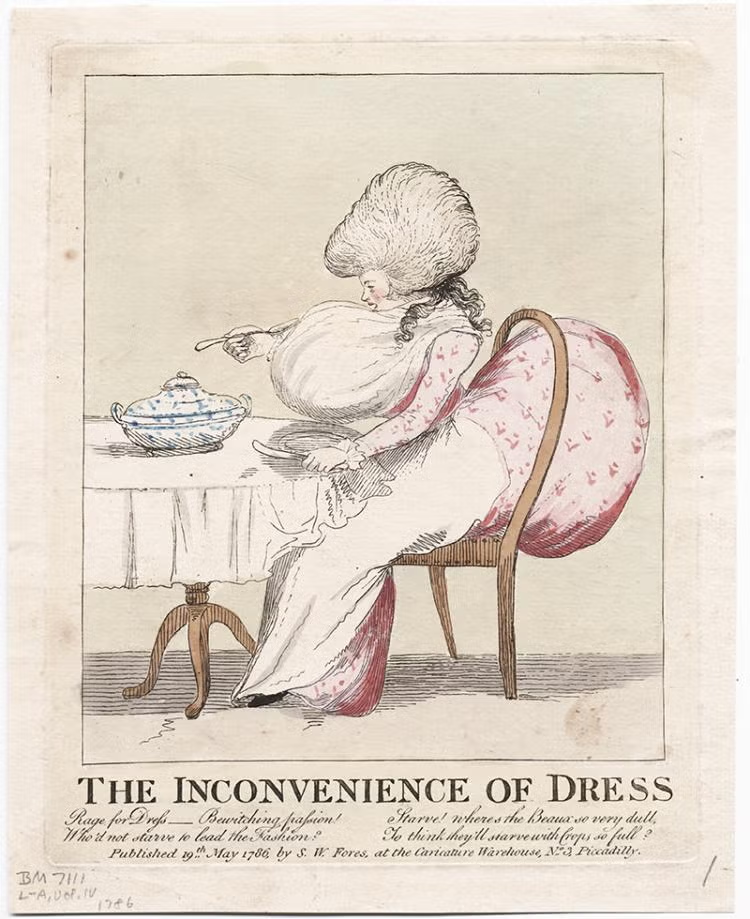
Newspapers were normally around four pages, while pamphlets were longer at less than a hundred pages stitched together with soft covers. Satirical prints were single sheets, featuring government corruption, sexual hypocrisy, royal excess, moral crisis, and fashion fads. All three were purchased to attract customers to coffee houses and keep them there. The prints could be low-brow caricatures or sharp political or social critiques from the likes of Hogarth, Gillray, or Rowlandson. And they were often ruthless. And for those who were the targets, it was often the case that explaining in court why the cartoon was offensive was worse than ignoring it. After all, public attention would move on to the next target soon enough.
In the nineteenth century the advent of industrial printing brought a boom in newspapers, magazines and periodicals, and the nature of the content varied depending on the target market. Some sought to educate, some to sensationalise, and others simply to entertain. Political cartoons evolved alongside simple gags using these publications a platform, and both art forms use recognisable archetypes or caricatures to make complex subjects digestible. Political cartoons simplify politicians into heroes or villains, while general cartoons use broad character tropes to communicate moral or comedic points quickly. And both were popular, with certain comic strips developing enough of a following to make the press keen to keep publishing it as their customers wanted to know what these characters were up to today.

Magazines such as Punch were packed with cartoons, some social commentary, some political, and some just for chuckles. Some became famous, such as the Darwin monkey by Faustin Gabriel Betbeder that featured in The London Sketchbook 1874, but in this post, I’m going to concentrate more on the frivolous side of the Victorian cartoon that became immensely popular and are now largely forgotten.

Comics; magazines just full of comic strips, became a big success in the mid-nineteenth century. We think of these as being aimed at children, but they were originally aimed at semi-literate, working-class adults and replaced text stories with pictures. It was only later that the format was seen as being childish as people became more educated. Penny dreadfuls (also known as penny bloods, penny horribles, penny awfuls, penny numbers, pulp fiction, and dime numbers) carried serialised stories that ran from week to week and contained tales such as Varney the Vampire, Spring-Heeled Jack’, pirates, highwaymen (especially Dick Turpin), and detectives like Sexton Blake were popular for decades. They were shorter and written at a level that was practicable for lower educational standards. As soon as a character or plot line became popular, naked copies appeared in rival publications with no more than a cosmetic name-change or copying the story or genre.
At an even simpler level, publications with only comic strips appeared to meet the demand for cheap, crude entertainment. In 1874, Scottish publisher James Henderson published Funny Folks and that established the model for comics that still persists today. Others followed; Ally Sloper’s Half-Holiday in 1884; featuring a working-class character whose roguish image was one which many readers wished they could emulate, but allowed them to vicariously ‘stick it to the establishment’ as the eponymous hero evaded work, debts, and over-indulged in anything that pleased him. In a world where the temperance movement was trying to reform the ‘undeserving poor’, his red nose even celebrated hard drinking. He was the first recurring character in a dedicated strip.
Comic cuts appeared in 1890, and it swapped dense text for sequential cartoon strips with minimal text captions, quickly becoming a massive favourite across Britain. Illustrated Chips appeared in 1890, and it famously debuted the long-running slapstick tramp cartoon strip Weary Willie and Tired Tim in 1896, which followed two lazy wanderers trying to dodge honest work due to their preferrence for a life of larcency and laziness.

Ally Sloper is of particular note, not only because I mention him in a book, or that he was the first recurrent character. He became spectacularly popular and his influence extended internationally right into the twentieth century. Heavily merchandised, he even influenced Charlie Chaplin’s ‘little tramp’ character, but W.C. Fields is the most obvious version in the way he presented himself in his vaudeville act.

Sloper appeared in three movies and merchandising sold well; everything from playing cards, pocket watches, door stops and vesta cases, figurines and pipes. He was a propaganda tool for the British government’s policies, frequently leaning into pro-royalty and pro-Empire storylines that appealed to the working class given that they had been educated to think that way from childhood. Sloper even featured in a popular song; “Ally Sloper’s Christmas Holidays” in 1886.
Sloper was originally said to have been created by Charles H. Ross, later fully illustrated by his wife Émilie de Tessier under the pseudonym “Marie Duval”. From 1884 -1888 he was illustrated by William Baxter. The series finally ended in 1916, but the character’s influence continued in the actors who grew up reading him right into the twentieth century.
However, recent historians have been studying then work of Émilie de Tessier, and a growing school of thought has come out of a research project at the University of Chester that her husband took the credit for her work. The eminent historian of comics, David Kunzle, argues that Marie Duval was the real creative force behind Ally Sloper. He finds the role credited to her male collaborator suspiciously nebulous. Anyway, even if Ross did invent the character, it was Duval who drew it in the 1860s and 70s, when Ally Sloper became a pop art icon. His evidence is based on studying her extensive catalogue of work and noting the evolution of the character. Kunzle proved that Duval took over full cartooning duties as early as 1869. She drew the character for over 15 years, meaning she was the one who actually developed Sloper’s signature visual identity, world, and supporting cast. He designated Duval as Europe’s first female professional exponent of caricature.
Émilie de Tessier, also known as Marie Duval, lived a colourful life of her own. She was born in London to French parents and gave up being a governess to take to the stage, which is where she adopted the name Duval. She joined three other women cartoonists contributing to the British satirical magazine Judy, edited by Ross, signing her work as Marie Duval. She was named in a high profile divorce case as correspondent due to her affair with Herbert Augustus Such in 1873, who went by the stage name Augustus Granville. A year later, Duval had a child with Charles Henry Ross, and the family lived in Battersea. She adopted the name Ross but there are no records of a marriage. His first wife died in 1876. He died in 1879 after what was described as ‘a long and painful illness’, and she died in 1890 of bronchitis, pneumonia and nephritis aged forty-two, leaving behind her sixteen-year-old son, also named Charles. He also became an artist.
May 3, 1873 Daily News
A Theatrical Divorce Case: Such vs. Such
“It appeared that in the autumn of 1870 the petitioner (then a Miss Harvey) and her mother were living at a place called “The Cedars” at Putney, which was a boarding-house kept by the respondent’s mother. An intimacy sprang up between her and the respondent who lived with his mother there, and they were married in November 1870. The petitioner was at the time 24 and the respondent 19 or 20 years of age. The lady was possessed of some £5000 or £6000, and the respondent was an actor employed at the Holborn and Globe Theatres, and he told his wife that he could make from three to four pounds a week. After the marriage they resided at “The Cedars” as before, for some time, and then they removed to Tredegar-road, Brompton. Very soon after the marriage the respondent exhibited symptoms of irregular habits; he stayed out very late at night and sometimes did not come home at all. He also gave up doing anything to earn a living, and on the petitioner remonstrating with him he struck her on the head with a poker. The blow cut her head and blood poured from the wound. The petitioner’s mother entered the room at the time, but she did not see the blow inflicted, and the petitioner told her that she had accidentally knocked her head against the chimney-piece and cut it.
On the 9th of October, 1871, the respondent, whose theatrical name was Augustus Granville, took his wife to the Globe Theatre to see a rehearsal of “Fal-sae-ap-pa.” He there introduced her to Marie Duval, and on leaving the theatre they went to some wine-rooms, where they met that lady. The petitioner, having seen some familiarities pass between her husband and Miss Duval at the theatre, charged him with it on the way home, when he got into a passion, and told her that he liked her much better than his wife. That night the petitioner refused to stay with her husband, and she never did so afterwards, having separated from him in November following. Besides the act of cruelty already alluded to, the respondent was stated to have struck his wife on other occasions, while he was continually taunting her about Miss Duval. On one occasion when she was ill in bed, in the presence of the doctor who attended her, he took from his pocket a photograph of Miss Duval dressed in male attire, and asked the doctor whether she was not far preferable to his wife, and whether she did not look nice in men’s apparel.
In respect to the adultery, Mrs. Unwin stated that she lived in Nelson-square, Blackfriars-road, and in the summer of 1870 Miss Duval came to lodge in her house. After she did so she was visited by the respondent, who went by the name of Granville and often remained with her all night. In the autumn of 1871 she got so disgusted with their conduct that she had them both turned out of the house. The Court considered that both charges had been proved and pronounced a decree nisi with costs against the respondent.”